
Best Time to Visit South Korea: Seasons, Blossoms and Regional Routes
The best time to visit South Korea for a first sightseeing trip is April–May or October, when walking between palaces, markets and historic neighborhoods is generally more comfortable than in the humid summer or cold winter. Choose October if you want an autumn trip without making cherry blossoms the condition for success. Choose spring for flowers, but keep your route flexible: flowering moves across the country and changes from year to year.
For beaches, the answer shifts toward summer; for skiing, toward winter. Seoul, Busan, Jeju and the Gangwon mountains do not have interchangeable conditions. Start with the experience you want, then choose a region and month together. Korea Tourism Organization’s climate guide provides the seasonal framework behind these recommendations.
Best time to visit South Korea by priority
| Priority | Suggested window | Tradeoff |
|---|---|---|
| First city-and-culture trip | April–May or October | Choose spring or autumn; retain rain alternatives |
| Flowers | Spring, varying by region | No confirmed 2027 bloom forecast |
| Autumn landscapes | October into early November, location dependent | Higher and northern places can change earlier |
| Beaches | Summer | Heat, rain and storms can affect plans |
| Winter activities | Winter, operator dependent | Verify operations and dress for the actual base |
A spring or autumn date is not a guarantee of clear skies. Keep one indoor option near each outdoor neighborhood rather than crossing Seoul repeatedly when a shower arrives. If flowers or foliage matter, spend several nights in a base and make day trips according to current observations. A fixed one-night stop at a single famous tree gives you less room to adapt than a broader regional itinerary.
Four regions, four planning decisions
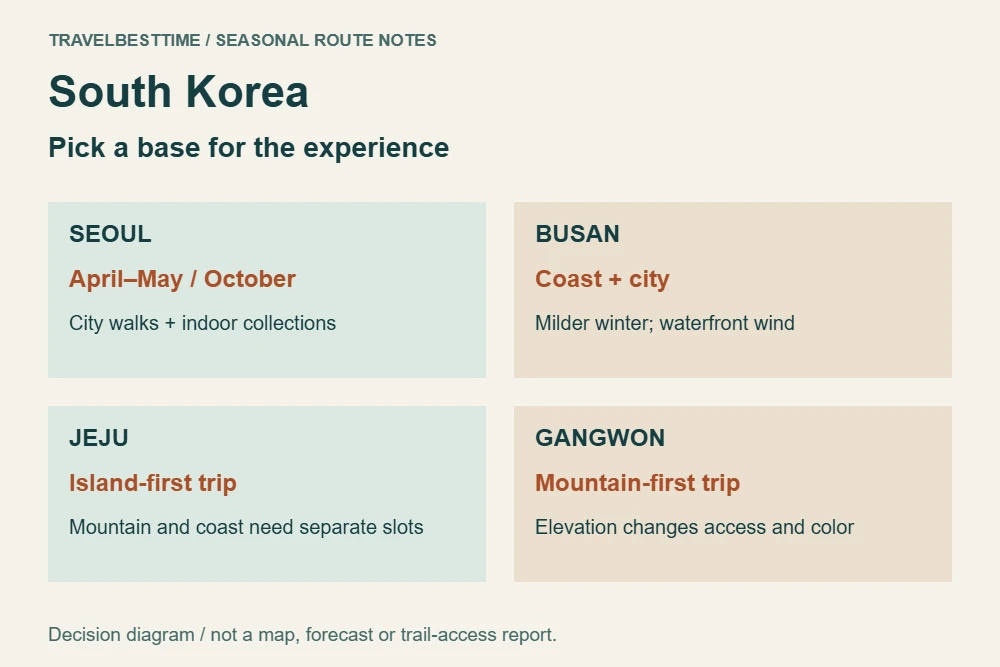
Seoul is the city-and-culture choice for April–May or October: group a palace visit and nearby historic neighborhoods into one walking day, then give museums and a different district another. In winter, shorten exposed river walks and use indoor collections as the day’s anchor. In summer, reduce the amount of sightseeing dependent on long midday walks. The Korea Tourism Organization climate guide provides the seasonal framework; the Seoul table below remains a station reference, not a street-level forecast.
Busan suits a coast-and-city stay even outside swimming season. Separate the waterfront day from the market-and-cultural day, so wind need not cancel the whole visit. Its milder winter makes it a different proposition from Seoul, while summer beach plans still carry heat, rain and storm exposure. Busan’s official seasonal guide supports that southern-coast distinction. April–May and October are choices for sightseeing here, not claims of warm sea temperatures.
Choose Jeju when the island itself is a priority, rather than adding it as a quick extra between Seoul and Busan. Give a mountain hike and coastal sightseeing separate slots: mountain conditions and island transfers need more room than a city walk. A coast-first visit offers an alternative when a summit plan is unsuitable, but the island is not a guaranteed escape from summer storms. This guide supplies no Jeju station series or verified transfer duration.
Gangwon is the mountain-focused alternative to some city nights. Spring conditions in Seoul do not establish that high trails are clear of winter weather; in autumn, cooler high ground can change earlier than southern lowlands. The National Atlas of Korea documents this geographical progression. Use a dedicated mountain base if hiking is the purpose, with trail access and a local forecast determining the actual outing rather than a national foliage date.
Monthly weather: Seoul as one reference station
Reference: Seoul (47108), 37.57 N, 126.97 E, 86 m. Historical period: 1991–2020. Mean temperature in °C; monthly precipitation in mm. Station climate source. These figures are not a forecast or a national average.
| Month | Mean temperature (°C) | Precipitation (mm) |
|---|---|---|
| January | -1.9 | 16.4 |
| February | 0.7 | 28.1 |
| March | 6.1 | 36.9 |
| April | 12.6 | 71.7 |
| May | 18.3 | 103.7 |
| June | 22.7 | 129.6 |
| July | 25.3 | 414.5 |
| August | 26.1 | 348.3 |
| September | 21.7 | 141.6 |
| October | 15.1 | 52.1 |
| November | 7.5 | 51.2 |
| December | 0.2 | 23.7 |
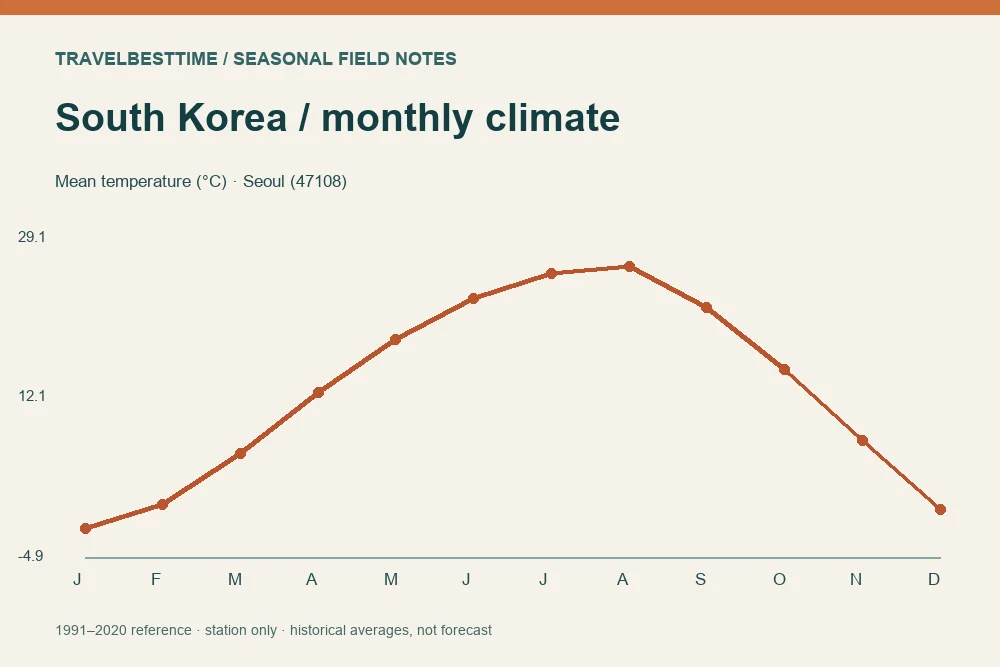
Use the table to compare seasons in Seoul, not to estimate the weather on Jeju or a high trail. The mean combines warmer and colder parts of the day. Precipitation is a monthly total, including water-equivalent frozen precipitation where reported; it does not tell you how many hours of a particular holiday will be wet. Differences from other published tables can reflect data processing, so this guide uses one series consistently.
What each month means for your trip
January suits a winter-focused visit if you are comfortable dressing for cold conditions. Keep city days compact and choose winter activities through operators whose current access and equipment arrangements you can verify.
February remains a winter month. Before fixing intercity journeys, check the year’s Seollal holiday calendar and actual train availability; a lunar holiday should never be copied from last year’s dates.
March is a transition rather than a nationwide blossom guarantee. A southern route can have a different seasonal feel from Seoul, so select the trip for food, history and neighborhoods as well as flowers.
April is a strong spring choice. Blossoms can draw concentrated crowds, but flowering is brief and variable. Build several possible viewing stops into the route instead of promising one exact peak day.
May favors walking and a broader mix of outdoor plans. Carry a layer for evenings and check the forecast for longer hikes; comfortable city weather does not remove mountain exposure.
June becomes warmer, with summer rain becoming more relevant later in the month. A flexible museum-and-neighborhood itinerary is easier to adjust than a chain of weather-dependent outdoor tours.
July is the wettest month in the reference table. Allow for substantial rain disruption, keep important transfers away from the last possible connection and respect trail closures rather than treating rainfall as a minor inconvenience.
August is hot in Seoul’s historical record. Coastal recreation may be the purpose of the trip, but storms can disrupt it. Book activities with clear cancellation terms and keep an alternative to a full day outdoors.
September gradually moves toward autumn, but early-month heat and storm exposure are still relevant. Check Chuseok timing before booking a rail-heavy journey; the holiday date changes with the calendar.
October is the most straightforward autumn recommendation for a general first visit. Combine Seoul with a southern city or a mountain-area base, leaving foliage viewing flexible rather than scheduling by a nationwide peak date.
November works for travelers happy with cooler days. Early and late November can feel quite different, and autumn color farther south should not be assumed to last throughout the month.
December brings a winter rhythm again. Choose a central base, plan warm meal breaks and verify seasonal attraction operations. Festive city scenes and ski plans require different clothing and transport choices.
Blossoms, foliage and festivals in 2027
Cherry blossoms are a seasonal pattern, not a confirmed 2027 forecast. Likewise, historical foliage timing should guide the shape of a route rather than a nonrefundable booking around a particular tree. Consult updated official observations closer to travel and distinguish the first opening of flowers from full bloom.
The Busan International Film Festival organizer displayed its October 6–15, 2026 edition during research. Those dates are historical evidence only; this guide does not assign them to 2027. If screenings are your reason for visiting, wait for the organizer’s dated 2027 program and check ticket rules before paying for a festival-centered stay.
Seollal and Chuseok can change the feel of a trip through family travel, transport demand and individual business closures. Check the official calendar for the travel year, then confirm the opening hours of your actual stops. Neither a national holiday nor a festival means that every attraction closes or that every neighborhood becomes busy in the same way.
A practical seven-night spring or autumn route
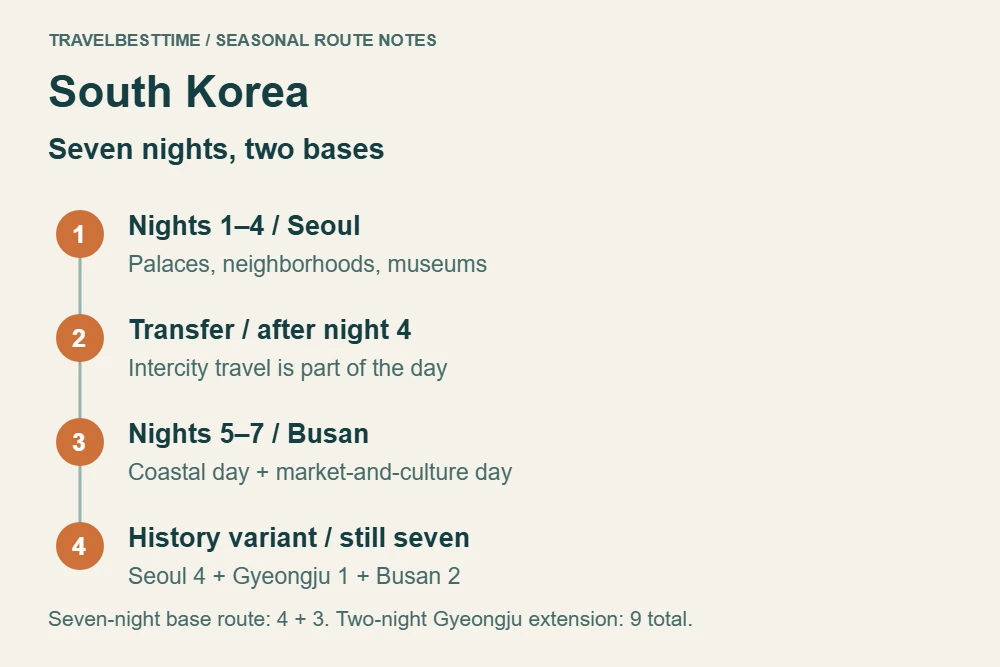
Use four nights in Seoul followed by three in Busan: nights 1–4 and nights 5–7 total seven. Arrival and departure are travel days, so this is not a promise of eight full days of sightseeing. It works most simply when the departure arrangement fits the southern end of the route; a return to Seoul needs its own allowance.
In Seoul, use the first full day for a palace and nearby historic neighborhoods, the next for a different district and museums, and the remaining full day for the outdoor visit that best fits the weather. In April–May, flowers can complement that heritage route without becoming its only purpose. In October, prioritize longer city walks and leave foliage viewing to current conditions rather than a fixed peak-date reservation.
Move to Busan between the fourth and fifth nights. Treat the intercity journey as part of that day’s plan; this guide does not supply a train duration, fare or guaranteed departure. Use one full Busan day for coastal neighborhoods and another for markets and culture, swapping their order if the waterfront is windy or wet. Spring and autumn suit this sightseeing combination even when swimming is not the goal.
For a history-focused seven-night alternative, use four nights in Seoul, one in Gyeongju and two in Busan: 4 + 1 + 2 = 7. Gyeongju replaces one Busan night; it does not get added to the original seven. This introduces another hotel move and reduces Busan time. Choose a few heritage stops from the official itinerary below instead of trying to see every site on the transfer day.
For a slower extension, keep Seoul’s four and Busan’s three nights and add two in Gyeongju: nine nights total. Jeju or a dedicated Gangwon mountain stay is another route choice, best made by replacing city nights or extending the trip, rather than silently increasing a seven-night checklist.
Crowds, booking choices and packing
Popular blossom locations, autumn viewpoints, domestic holidays and major events can concentrate demand. Compare the specific dates and bases you intend to use; this guide has no verified fare or hotel-rate series and cannot name a cheapest month.
For the Seoul–Busan route, secure the rooms and intercity connection that fix the sequence, then leave the order of coastal and indoor days adjustable. If adding Gyeongju, decide which Busan night it replaces before reserving hotels. For a Jeju alternative, protect the onward connection instead of putting a major hike immediately before departure.
Pack layers for April–May or October city walks, plus rain protection and shoes suited to long days on foot. Busan’s waterfront needs a wind layer even when the city feels mild. Gangwon high ground and Jeju mountain plans need clothing based on their own forecast, not the Seoul monthly mean. Summer calls for heat breaks; winter for insulated layers and footwear suited to the actual conditions.
Add depth with a Gyeongju heritage stay
The official Korea Tourism Organization heritage itinerary identifies Bulguksa Temple, Daereungwon Ancient Tomb Complex, and Donggung Palace and Wolji Pond. Choose Gyeongju for these heritage visits, with flowers or foliage as a seasonal addition rather than the sole reason for the stop.
For the one-night substitution described above, prioritize a small selection of those sites. They are not all one compact walking district, so a long attraction list competes with arrival, local journeys and the onward move to Busan. The two-night extension allows a less compressed visit. This guide establishes no bus frequency, admission price or evening opening schedule.
In April–May, choose the temple and historical sites you want to see even if flowers have finished. In October, apply the same rule to autumn color: a heritage-centered day remains useful when foliage is early or late. Use the official itinerary to select stops, then obtain current access and operating information for the visits you actually choose.
South Korea travel FAQs
What is the best month for a first trip to South Korea?
October is a strong starting choice for a general city-and-culture itinerary. April and May are useful alternatives for spring travel. Choose your exact dates around the regions and activities you want, then check current weather and holiday information.
Is April guaranteed to have cherry blossoms in Seoul?
No. Flowering dates and the length of full bloom change each year. April is a useful planning window, but a flexible itinerary with several possible viewing locations is more reliable than a single fixed blossom day.
Is July a bad time to visit South Korea?
July can work for a flexible city trip, but Seoul’s historical rainfall is high. It is a less straightforward choice for a holiday built around uninterrupted hiking, outdoor photography or tightly connected weather-sensitive activities.
Is Busan warmer than Seoul in winter?
Busan generally has milder winter conditions than Seoul and the inland north. Coastal wind and day-to-day changes still matter, so pack for the local forecast rather than assuming that milder means warm beach weather.
Can I combine Seoul, Busan and Jeju in one week?
It is possible to arrange many transfers, but this guide recommends fewer bases for a first seven-night trip. Choose Seoul and Busan, or substitute Jeju with enough nights to absorb an island weather disruption.
Are the 2027 Busan film festival dates confirmed here?
No. The organizer page inspected displayed the 2026 edition. Check the official 2027 announcement before booking travel around screenings; the old October dates are not a confirmed future schedule.