Best Time to Visit Canada: Cities, Rockies, Fall Color and Winter
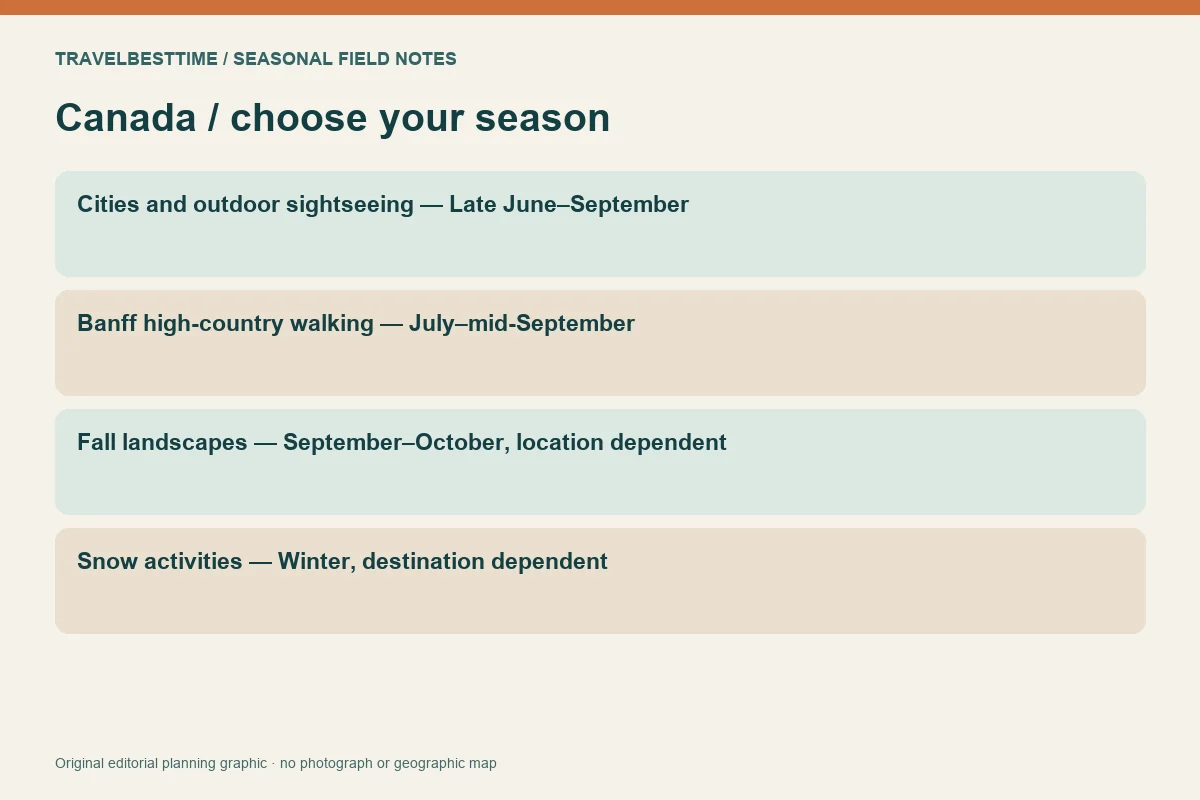
The best time to visit Canada for a first trip combining cities and outdoor sightseeing is usually late June through September. For higher-elevation walking in Banff, narrow that recommendation: Parks Canada identifies July to mid-September as the prime hiking season. Winter is a separate trip choice for snow activities, not simply the summer itinerary with a warmer coat.
Canada is too large for one national weather answer. Vancouver, Toronto, Montréal, the Rockies, Atlantic Canada and the far north need different plans. Pick one region or a realistic combination, then select dates for its actual access conditions. September can be a useful compromise, but it does not guarantee late-season mountain access or peak foliage everywhere.
Best time to visit Canada by trip type
| Priority | Suggested window | Tradeoff |
|---|---|---|
| Cities and outdoor sightseeing | Late June–September | Choose a realistic region |
| Banff high-country walking | July–mid-September | Parks Canada access and trail reports lead |
| Fall landscapes | September–October, location dependent | Color is variable, not guaranteed |
| Snow activities | Winter, destination dependent | Book an actual winter operation |
| Remote or island route | Operator season | Confirm transfer and service dates |
If the turquoise-lake and high-trail version of the Rockies is your main goal, prioritize the access season over a general claim about spring value. If museums, food and urban neighborhoods are the focus, you have more freedom to travel outside summer. For a winter holiday, choose a base with the activities and transport you need rather than assuming every scenic summer stop operates in the snow.
Separate the regions before choosing a month
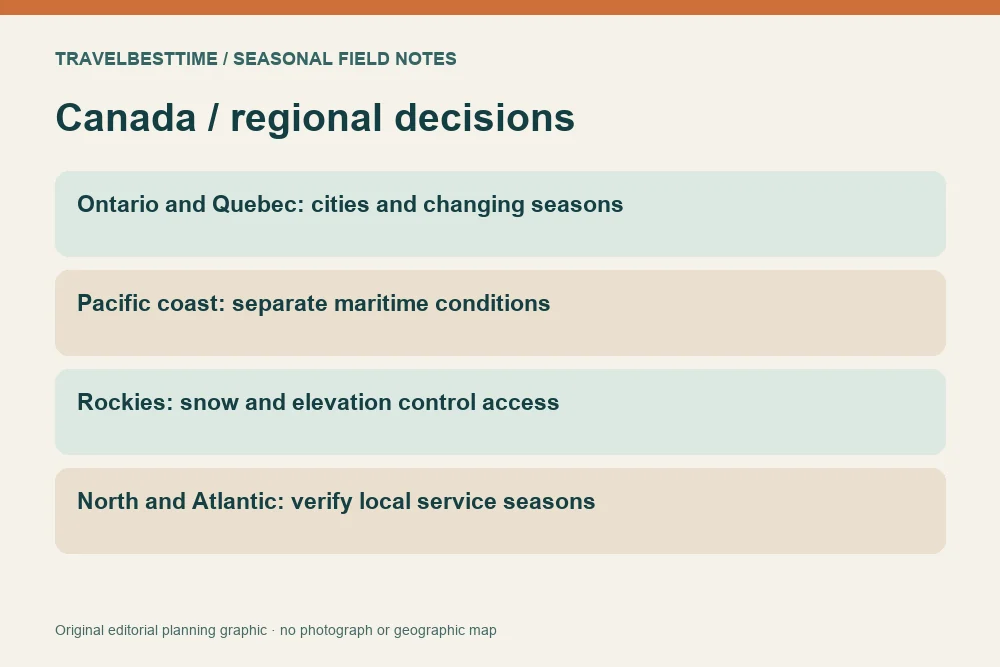
Southern Ontario and Québec support a city-focused summer or early-autumn trip. In winter, build shorter outdoor sections into the day and confirm the transport connections you intend to use. Autumn color varies with location and conditions; a route with several woodland stops is less fragile than a booking tied to one promised peak date.
The Pacific coast needs its own climate reference and current forecast. Do not apply Toronto’s winter temperatures to Vancouver, or assume that coastal conditions describe the mountains nearby. A city break and an alpine outing can require quite different equipment even when they begin from the same accommodation base.
In the Rockies, elevation changes the calendar. Snowbound passes and avalanche exposure can persist after low-elevation urban spring has arrived. Parks Canada notes that many passes remain snowbound until late June and some trails retain snow well into summer. That is why a May booking should be built around confirmed accessible activities rather than a copied midsummer hiking list.
Atlantic and northern itineraries add further transport and operating-season questions. Before booking a remote lodge, ferry-dependent route or northern experience, confirm the actual service dates and transfer arrangements. A countrywide best-month answer cannot establish local access, and a flight connection on a map is not a verified timetable.
Monthly weather reference: Toronto Pearson
Reference: Toronto Lester B. Pearson International Airport (71624), 43.68 N, 79.63 W, 173 m. Historical period: 1991–2020. Mean temperature in °C; monthly precipitation in mm. Station climate source. These figures are not a forecast or a national average.
| Month | Mean temperature (°C) | Precipitation (mm) |
|---|---|---|
| January | -5.5 | 67.1 |
| February | -4.0 | 40.8 |
| March | 0.2 | 48.5 |
| April | 7.0 | 78.3 |
| May | 13.6 | 77.0 |
| June | 18.8 | 79.8 |
| July | 21.1 | 68.0 |
| August | 20.4 | 62.4 |
| September | 15.8 | 71.2 |
| October | 9.5 | 48.4 |
| November | 3.7 | 63.9 |
| December | -2.4 | 50.6 |

This is an airport station in southern Ontario, not a Canadian national average. Winter precipitation includes the water-equivalent amount of frozen precipitation where reported; a millimeter total is not a snow-depth forecast. Airport and city-center conditions can differ. Use a separate local forecast and access information for each region you include.
Canada month by month
January is a winter-trip month. Choose activities and accommodation together, and allow time for weather-related delays rather than designing the route around the last available connection.
February supports winter-oriented travel, but snow conditions and individual attractions need current confirmation. A city-and-museum itinerary also works if you are comfortable limiting outdoor exposure.
March can still mean winter in mountain and northern areas. Do not assume that the seasonal label spring establishes open hiking trails or snow-free roads.
April is more useful for flexible urban travel than a guaranteed alpine itinerary. Check which excursions actually operate and leave room for wet, cold or transitional conditions.
May can suit lower-elevation sightseeing. In Banff, use official trail reports and select appropriate low-level alternatives rather than treating all famous hikes as ready for visitors.
June offers longer outdoor days, but high-country snow remains a planning issue. If walking at elevation is central, distinguish the beginning and end of the month and verify current conditions.
July is a straightforward choice for a Rockies summer trip, with advance planning for accommodation, transport and popular access points. Open season does not mean that every trail is suitable or unrestricted.
August remains useful for outdoor touring. Check wildfire, smoke and closure notices close to travel; a historical climate average cannot tell you whether your chosen route is currently available.
September balances city touring and many outdoor possibilities. Early September is easier to fit within Banff’s usual hiking window than a late-month trip dependent on high trails.
October is an autumn city-and-landscape choice in parts of the south. Plan foliage as a changing natural event, and check seasonal service reductions before extending the trip into remote areas.
November is a transition for many visitor itineraries. Verify whether the particular attraction you want is open rather than assuming summer services continue until winter activities begin.
December suits a deliberately winter-focused trip. Holiday travel, daylight, road conditions and the final airport transfer deserve as much attention as the attraction list.
Mountain access: reservations do not override conditions
Parks Canada’s Banff closures and restrictions page distinguishes seasonal wildlife restrictions, road closures and other limitations. It also warns that additional restrictions can arise without advance notice. Check it again near travel; a saved old itinerary is not clearance to enter a closed area.
Moraine Lake Road is closed to personal vehicles under the policy listed during research. Do not plan on driving a rental car to the lakeshore because a mapping app shows a road. Confirm the current approved access options, reservation requirements and operating dates through Parks Canada before committing accommodation around that visit.
Avoid putting an essential flight immediately after a remote drive or long hike. Keep a transfer buffer and a lower-elevation alternative. If a trail is closed, change the activity; do not substitute an unfamiliar route solely because it appears nearby on a map. Snow, wildlife restrictions and weather can affect neighboring routes differently.
Events and 2027 dates
The official Formula 1 2027 calendar lists the Canadian Grand Prix for May 21–23. That is a dated announcement relevant to Montréal travel, not evidence that every Canadian city has the same hotel-demand pattern. Recheck the event and local transport arrangements before booking around it.
Canada Day falls on July 1 annually, but the operating details of local celebrations need their own current program. Likewise, city festivals should be checked with their organizers. This guide does not invent 2027 music-festival dates, ticket prices or a timetable from an earlier edition.
For a trip unrelated to an event, compare dates near major venues and national holidays before choosing accommodation. A quieter week in one city may coincide with a busy period in another. There is no verified national hotel-price series behind this article, so it makes no cheapest-month or fixed-savings claim.
Two practical routes instead of one rushed crossing
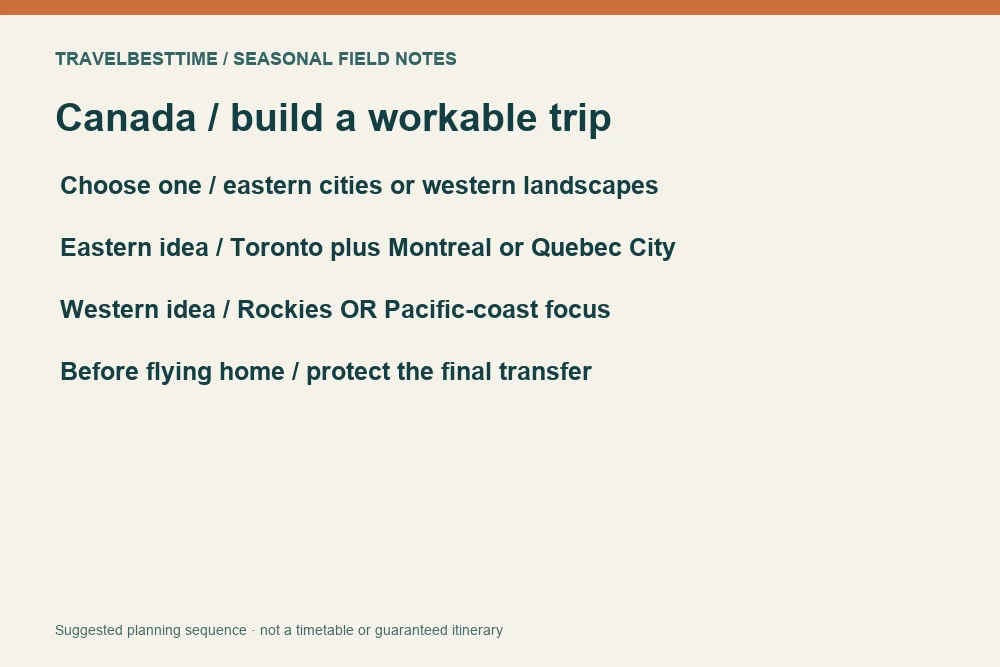
For seven nights in the east, begin with Toronto and choose either Montréal or Québec City as a second main base, according to your transport plan and interests. Keep a full day for each substantial transfer and leave room to explore neighborhoods without timed entries. Add a countryside stop only if it fits the dates and does not reduce both cities to arrival evenings.
For seven nights in the west, choose a Rockies-focused route or a Pacific-coast-focused route. A Rockies plan might use Banff and the Lake Louise area, with activities selected from current park information. A coastal plan can favor Vancouver and a carefully checked nearby extension. Combining every major western region in one week creates a transport-heavy holiday and weakens your ability to respond to weather.
With two weeks, a flight between regions may be reasonable, but it still consumes time and needs a verified connection. Work backward from the final departure, particularly when the route includes a ferry or remote transfer. These route suggestions are editorial pacing advice, not confirmed transport schedules or promises of attraction availability.
Packing and the booking order
Choose the route’s hardest-to-replace element first: a park-access reservation, remote accommodation, specialist tour or event ticket. Then fit transport and ordinary city activities around it. Read cancellation conditions and record which bookings depend on a weather-sensitive service.
For summer, pack layers and rain protection rather than only hot-weather clothing. For mountains, use the expected trail conditions and local guidance to determine equipment. Winter requires a much more specific clothing and transport plan; do not use Toronto’s monthly mean as a substitute for the forecast at a ski resort or northern base.
Travelers considering a broader North American nature trip can compare the site’s Alaska package after its publication state and URL are safely verified. That comparison should help choose between trips, not turn a Canadian week into an unrealistic cross-border extension.
A Pacific-coast alternative: Stanley Park without a rigid loop
If you choose Vancouver over a Rockies itinerary, Stanley Park can provide a substantial outdoor day without adding a long-distance transfer. The City of Vancouver’s seawall information distinguishes walking and cycling space and publishes maintenance information. Consult its current notices before treating a complete waterfront circuit as available. A route that follows a shoreline still needs access checks.
During research, the city described a dated October–November 2026 closure. That notice illustrates why the latest page matters, but it is not a confirmed closure schedule for 2027. Do not copy its dates forward, and do not assume a recommended detour has the same surface or accessibility as the original route. Follow the posted instructions for the visit you actually make.
For a short city stay, choose a section that fits your interests and available time, with a meal or indoor stop afterward. You do not need to complete the longest possible circuit to make the park worthwhile. This is particularly useful when a changeable forecast leaves a limited comfortable window for walking.
Keep the distinction between Pacific-coast sightseeing and alpine travel clear. A successful low-level city walk does not establish that a mountain excursion outside Vancouver has similar conditions. If the trip’s main goal is higher-country scenery, research that outing separately and give it its own weather alternative. Choosing Vancouver is an opportunity to build a different Canadian holiday, rather than a substitute version of Banff whose seasonal limits can be ignored.
Canada travel FAQs
What is the best month for a first Canada trip?
July or August is straightforward for a summer-focused first trip, while September can suit cities and some outdoor routes. The best choice depends on the region; higher-elevation Banff hiking usually favors July to mid-September.
Can I hike Banff’s high trails in May?
Do not assume so. Parks Canada notes lingering snow and avalanche exposure into the early hiking season. Use current trail reports and choose suitable lower-elevation alternatives when high routes are not appropriate.
Is Toronto’s climate representative of Canada?
No. Toronto Pearson is one southern Ontario reference station. Pacific-coast, mountain, Atlantic and northern destinations require separate weather and access checks.
Can I drive my rental car to Moraine Lake?
The policy listed during research closes Moraine Lake Road to personal vehicles. Confirm current approved access, operating dates and reservation requirements with Parks Canada before building your itinerary around the lake.
When is the Canadian Grand Prix in 2027?
The official Formula 1 calendar inspected lists May 21–23, 2027. Recheck the event announcement and Montréal access arrangements before making nonrefundable plans.
Is winter the cheapest time to visit Canada?
This guide cannot establish that. Ski areas, holiday periods and city events have different demand patterns. Compare live quotes for your exact route and dates instead of applying a national cheapest-season rule.