Best Time to Visit Costa Rica: Pacific, Caribbean & Green Season Guide
December through April is the best-time-to-visit answer you’ll see everywhere for Costa Rica, and it’s only half right. That stretch is genuinely the Pacific coast’s driest, sunniest window — Manuel Antonio, Tamarindo, Guanacaste — but flip to the Caribbean side and those same months are some of the wetter ones, while September and October, the worst months for a Pacific beach trip, are often the Caribbean’s best weather all year. It’s a pattern that shows up elsewhere in the Americas too — Mexico’s Pacific and Caribbean coasts split on a similarly inverted schedule. Costa Rica runs on at least three climates in total, including a cloud-forest interior that barely notices the seasons at all — so the real question is which coast, not which month. Hawaii compresses a similar range of microclimates into an even smaller footprint, with windward and leeward coasts of the same island sometimes just a few miles apart.
Costa Rica Doesn’t Have a Season — It Has Two
The spine of mountains running northwest to southeast through the country splits it into two climate zones that operate almost independently. Storms that drench the Pacific side get wrung out crossing the highlands and arrive on the Caribbean side, when they arrive at all, on a completely different rhythm
Pacific coast (Guanacaste, Tamarindo, Manuel Antonio, the Nicoya Peninsula): A textbook dry/wet split. Verano (dry season) runs December through April — Liberia, the region’s driest weather station, averages around 4mm of rain in February and stays under 20mm through March, essentially zero. Invierno (rainy season) runs May through November, with afternoon showers that build predictably after lunch and clear by evening; October is the wettest month, averaging roughly 350mm.
Caribbean coast (Puerto Viejo, Cahuita, Tortuguero): No real dry season exists here. Rain is possible in any month — July averages around 500–530mm, its wettest, with December close behind at roughly 400mm — driven by trade winds off the Caribbean Sea rather than the Pacific weather system. But this coast has its own two mini dry spells — loosely February–March and September–October — and the second one lines up almost exactly with the wettest weeks on the Pacific side. September, the driest month on this coast, averages only around 160mm, a fraction of what July brings. That inversion is the single most useful fact in this guide if you’re weighing which coast to prioritize.
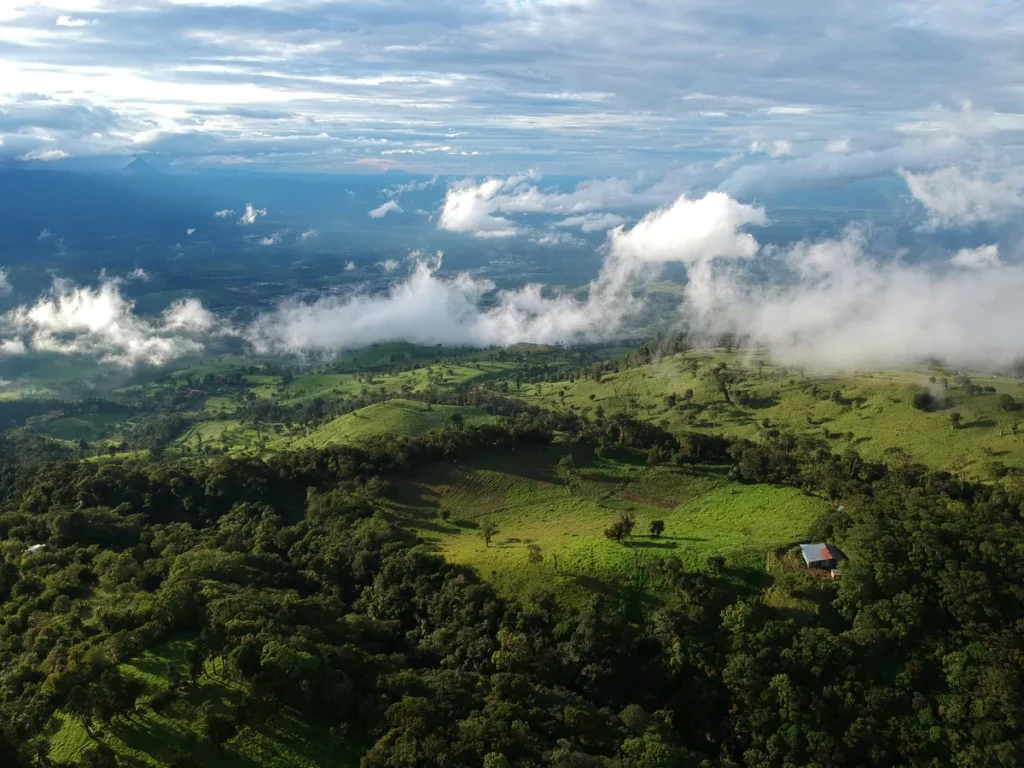
Central Valley & Highlands (San José, and the volcanic interior): Elevation does the work here instead of ocean currents. San José itself sits around 1,150m (3,800ft), high enough that temperatures stay in a narrow, mild band year-round — Ticos call it “eternal spring” — with a December–April dry season and a May–November wet season that’s gentler than either coast.
Arenal and Monteverde get their own section below, because lumping them into “the interior” undersells how different they are from each other and from everywhere else in the country.
Quick Reference: Costa Rica’s Climate Zones
| Region | Dry Season | Wet Season | Temp Range | Character |
|---|---|---|---|---|
| Guanacaste / Tamarindo | Dec – Apr (~4mm rain in Feb) | May – Nov (~350mm in Oct) | 75–95°F (24–35°C) | Driest, sunniest region in the country |
| Manuel Antonio / Central Pacific | Dec – Apr (shorter, wetter than Guanacaste) | May – Nov, heaviest Sep–Oct | 75–90°F (24–32°C) | Rainforest meets beach — more humid than the north |
| Caribbean (Puerto Viejo / Cahuita) | No true dry season — driest Feb–Mar & Sep–Oct (~160mm in Sep) | Rain possible any month, heaviest Jul (~530mm) & Dec (~400mm) | 77–90°F (25–32°C) | Warm, humid, lush year-round |
| Central Valley (San José, ~1,150m/3,800ft) | Dec – Apr | May – Nov | 59–79°F (15–26°C) | Mild “eternal spring,” cooler nights |
| Arenal / La Fortuna | Feb – Apr (still gets rain) | May – Jan, heaviest Jun–Aug | 70–85°F (21–29°C) | Northern lowlands rainforest — wet most of the year |
| Monteverde (~1,400m/4,600ft) | Jan – Apr, driest in March | May – Nov, heaviest Sep–Oct | 60–75°F (16–24°C) — significantly cooler | Cloud forest — misty and windy even in “dry” season |
Region by Region: What to Actually Expect
Arenal & La Fortuna
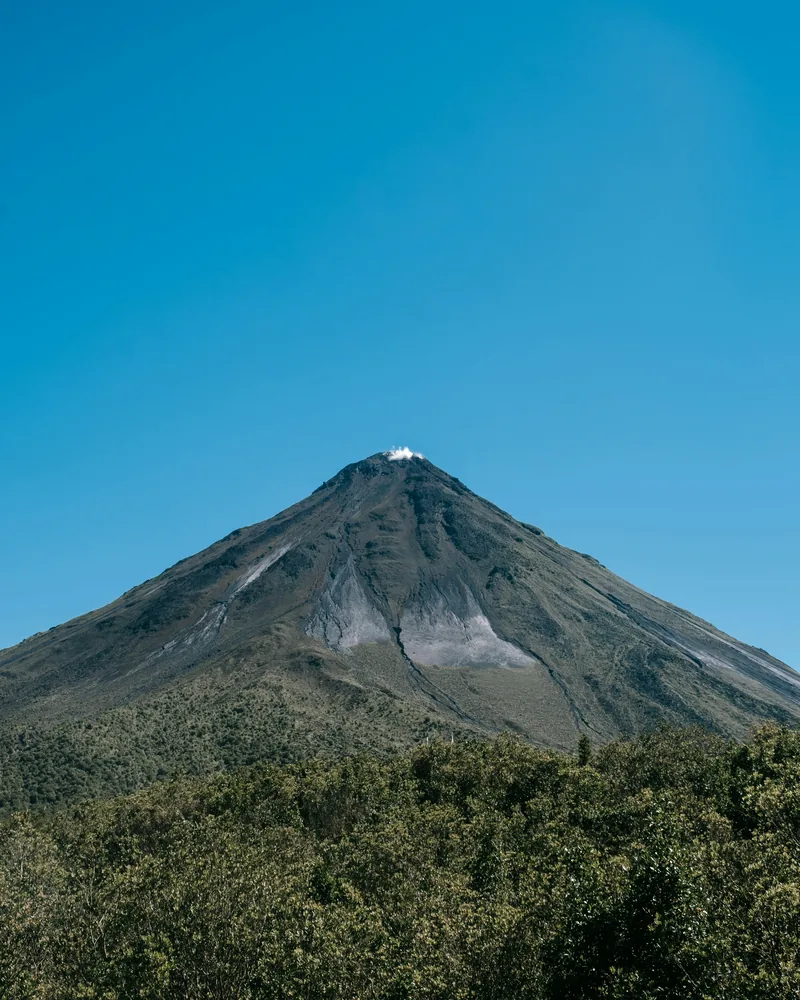
Arenal sits in the northern lowlands, not the highlands, and it’s genuinely one of the wettest parts of the country — rain is possible almost any week of the year, dry season included. The upside is that “dry season” here (loosely February through April) doesn’t mean dry so much as less wet, and it’s the best window for actually seeing the volcano’s cone without cloud cover, since wind picks up and moves the mist along faster. If clear volcano views matter more to you than avoiding rain altogether, aim for February–April or the veranillo, the mid-year dry spell that typically settles in from mid/late June through mid-July (and some years extends into a secondary dry stretch through early August).
Monteverde
Monteverde runs on its own logic entirely, because it’s a cloud forest — the mist and moisture aren’t weather, they’re the ecosystem. Sitting at roughly 1,400m (4,600ft) along the continental divide (parts of the reserve climb past 1,700m), it’s high enough that Pacific trade winds condense into cloud cover on contact with the mountain almost regardless of season. Even the driest month, March, still delivers regular light rain and near-constant cloud cover at altitude; the difference between “dry” and “wet” season here is measured in degree of mud on the trails, not sunshine. It’s also markedly cooler than anywhere else on this list — pack a light sweater regardless of when you go. Locals will tell you the misty months (September–October especially) are when Monteverde feels most like itself, and serious birders target the dry season specifically because it overlaps with quetzal breeding season.
Manuel Antonio
Manuel Antonio follows the Pacific pattern but with a twist: it’s wetter and more humid than Guanacaste even in dry season, because the central Pacific gets more rainfall generally. September and October are its soggiest stretch by a clear margin, but the town’s infrastructure is developed enough that rain rarely derails a trip — expect shorter, harder afternoon downpours rather than the drawn-out gray days you’d get elsewhere. It’s also one of the better bases for humpback whale season (see below), with solid August–September sightings just offshore.
Guanacaste & Tamarindo
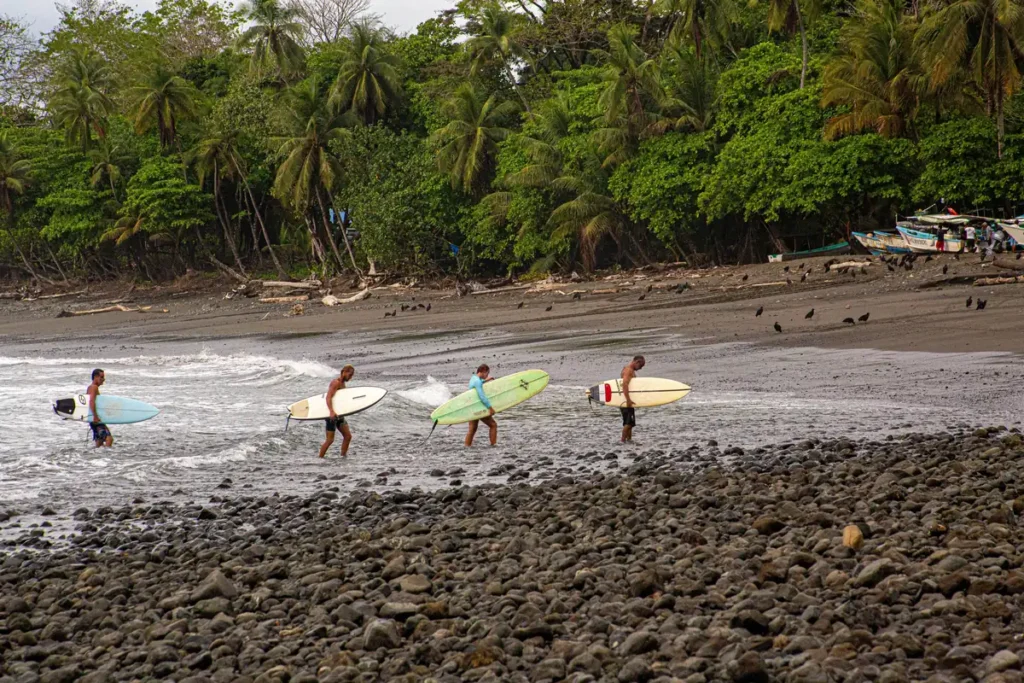
This is the country’s driest, sunniest corner, and it’s not close. December through April here can go weeks without measurable rain — February typically averages under 5mm for the entire month — which is exactly why it absorbs the bulk of Costa Rica’s beach tourism and carries the highest dry-season prices. If uninterrupted sun is the entire point of the trip, this is the region the rest of the guide is measuring itself against. It’s also prime surf territory nearly year-round, with the biggest, most consistent swells arriving during green season.
Caribbean Coast (Puerto Viejo, Cahuita, Tortuguero)
The Caribbean is the coast most Pacific-focused guides shortchange. It has no defined dry season — rain is a year-round possibility, heaviest in July (~530mm) and December (~400mm) — but it also isn’t locked into the Pacific’s May–November wet season. Its own driest windows, February–March and September–October, are genuinely pleasant: warm, sunny mornings, calmer seas, and none of the crowds, with September rainfall dropping to around a third of July’s total. The September–October overlap with the Pacific’s worst weather is the detail worth building an itinerary around if your dates are flexible.
Wildlife Calendar: Timing a Trip Around Whales and Turtles
Weather isn’t the only calendar running in Costa Rica. Two of the country’s biggest wildlife draws — humpback whales and nesting sea turtles — run on their own schedules, and they don’t always line up with the “best” weather windows above.
- Humpback whales (Pacific coast, especially Uvita, Marino Ballena National Park, and Manuel Antonio): Costa Rica gets two separate migrations. Southern Hemisphere humpbacks arrive from roughly July through November, with August–September the most reliable window for sightings. Northern Hemisphere (California) humpbacks pass through December to April, overlapping with dry season but in smaller numbers. If whales are the priority over dry weather, August–September in the South Pacific is the strongest bet.
- Olive ridley turtle arribadas (Ostional and Nancite, Pacific coast): These mass nesting events cluster around new moons roughly August through November, with July–October considered peak. Arribadas aren’t schedulable to the day, so a multi-night stay nearby improves the odds.
- Green turtles (Tortuguero, Caribbean coast): Nesting runs roughly July through October, peaking in August–September — which conveniently lines up with the Caribbean’s own drier stretch in September.
- Leatherback turtles: Split by coast and season — roughly October through February at Playa Grande and Playa Naranjo on the Pacific, and March through July at Cahuita and points south on the Caribbean.
The practical takeaway: a September–October trip built around the Caribbean coast doesn’t just dodge the Pacific’s worst rain, it also lands inside green turtle nesting season at Tortuguero — one calendar reinforcing the other.
The Green Season Case
“Rainy season” undersells what May through November actually looks like on the ground, which is why more of Costa Rica’s own tourism board and operators now market it as green season instead. A few reasons it’s worth taking seriously rather than treating as a fallback:
- Mornings are usually clear. The typical pattern — especially May, June, and November — is sun until early afternoon, then a predictable one-to-two-hour downpour, then clearing again. It’s rarely the all-day gray that “rainy season” implies.
- Prices drop and crowds thin across the board. Hotel rates typically run somewhere in the range of 20–40% below dry-season peak, with the deepest discounts in September and October; tours and car rentals see smaller but real cuts too, commonly around 10–20% off.
- The scenery is genuinely better. Waterfalls run fuller, the rainforest canopy is at its deepest green, and wildlife activity often increases.
- Veranillo exists. This mid-year dry spell — driven by a temporary shift in the Inter-Tropical Convergence Zone — typically runs from mid/late June through mid-July, and in some years is followed by a second, less pronounced dry stretch (locally called the canícula) into early August. It’s Pacific- and Central Valley-specific; the Caribbean doesn’t get the same reprieve. Timing and intensity vary year to year, so it’s worth checking the IMN’s seasonal forecast a week or two out rather than banking on an exact date.
- It’s the better call for wildlife-specific trips. Sea turtle nesting on both coasts and southern humpback whale season both peak within the green season, not the dry one, and river-level wildlife viewing (canoeing, kayaking) tends to improve as water levels rise.
The trade-off is real — muddier trails, less reliable outdoor plans, and the Osa Peninsula and South Pacific staying genuinely wet nearly year-round regardless of month. But framing it purely as “the season to avoid” misses why so many repeat visitors deliberately choose it.
Month-by-Month: Which Region Wins
Instead of one generic month-by-month calendar, here’s how the main regions stack up against each other for any given month — useful if you’re deciding where to spend limited days rather than just when to fly.
| Month | Guanacaste / Pacific | Caribbean | Arenal / Monteverde |
|---|---|---|---|
| Jan | Peak dry, best conditions | Mixed, can be wet | Windy, cool, mostly dry |
| Feb | Peak dry (~4mm rain) | Caribbean’s own dry spell begins | Good volcano visibility |
| Mar | Peak dry, hottest month | Driest Caribbean stretch | Monteverde’s driest month |
| Apr | Dry season winding down | Wetter again | Transitional |
| May | Green season begins, mornings clear | Rains begin earlier here than Pacific | Wet season starting |
| Jun | Consistent afternoon showers, veranillo starts late month | Wet | Better volcano visibility, fewer crowds |
| Jul | Veranillo dry spell (through mid-month) | Wettest month on this coast (~530mm) | Brief dry window mirrors Pacific veranillo |
| Aug | Good surf, secondary dry spell some years | Wet | Rainy but manageable |
| Sep | Wettest month on the Pacific | Caribbean’s best stretch — sunny, dry (~160mm) | Very wet, heavy cloud cover |
| Oct | Wettest month on the Pacific (~350mm) | Caribbean’s best stretch — sunny, dry | Wettest month for Monteverde |
| Nov | Shoulder — mix of wet and dry | Rains return | Transitioning toward dry |
| Dec | Dry season returns, peak pricing starts | Rainier, one of the wettest months here (~400mm) | Windy season begins |
Practical Notes
- Pack for both seasons no matter when you go. A light rain layer earns its space in the bag even in peak dry season, especially in Monteverde and Arenal.
- Book Guanacaste and Manuel Antonio early for December–April. Dry season is genuinely peak season, with pricing and availability to match — expect to pay noticeably more than the 20–40% green-season discount would suggest, since that discount is measured off these peak rates.
- If your trip spans both coasts, let the Caribbean’s calendar drive the itinerary, not the Pacific’s — visiting Puerto Viejo in September while the Pacific is drenched is one of the better-kept scheduling tricks in Costa Rica travel.
- Roads matter more than forecasts in the wet season. Some rural routes, particularly toward the Osa Peninsula and parts of the Caribbean south, get harder to manage after heavy rain — worth checking conditions if you’re self-driving.
Is it worth visiting Costa Rica in rainy season?
Yes, particularly May, June, and November, when mornings are typically clear and showers are predictable afternoon events rather than all-day rain. It’s also when prices drop — hotels are commonly 20–40% cheaper than dry season — and wildlife activity, including sea turtle nesting and southern humpback whale season, tends to increase.
What’s the best time to visit Manuel Antonio specifically?
December through April for the most reliable weather, but expect it to be more humid and rain-prone than Guanacaste even during dry season, since the central Pacific gets more rainfall overall. August and September add solid humpback whale sightings if wildlife matters more than dry skies.
Is Monteverde worth visiting in the rainy season?
Yes — Monteverde is a cloud forest, so mist and moisture are part of the ecosystem regardless of season. At roughly 1,400m elevation, it stays misty even in its driest month. Many repeat visitors prefer the atmosphere during the wetter months, even though trails are muddier and visibility is lower.
When is the best time to visit the Caribbean coast (Puerto Viejo)?
February–March and September–October are the Caribbean’s driest, sunniest windows, while July (~530mm) and December (~400mm) tend to be its wettest. September and October are especially valuable because they line up with the Pacific coast’s worst weather of the year — and with green turtle nesting season at nearby Tortuguero.
Do Arenal and Monteverde have the same weather?
No. Arenal sits in the northern lowlands and stays warm and rain-prone most of the year; Monteverde is a higher-elevation (~1,400m) cloud forest with cooler temperatures and near-constant mist. They’re often paired on itineraries but shouldn’t be treated as climate twins.
When can I see whales or turtles in Costa Rica?
Humpback whales pass through the Pacific coast twice a year: July–November (peak August–September) for the Southern Hemisphere population, and December–April for the smaller Northern Hemisphere group. Sea turtle nesting varies by species and coast, but green turtles peak July–October at Tortuguero, olive ridley arribadas cluster July–November on the Pacific, and leatherbacks split between October–February (Pacific) and March–July (Caribbean).
Weather patterns, prices, and event dates can change. Always verify current conditions and details with official sources before booking your trip. See our Disclaimer for more information.