Best Time to Visit Singapore: Rain, Heat, Festivals and Stopovers
The best time to visit Singapore for comparatively lower rainfall is often February, but there is no rain-free season. Heat and humidity remain part of a trip throughout the year. For a city break, your daily timetable and access to indoor alternatives can matter more than choosing between two nearby months.
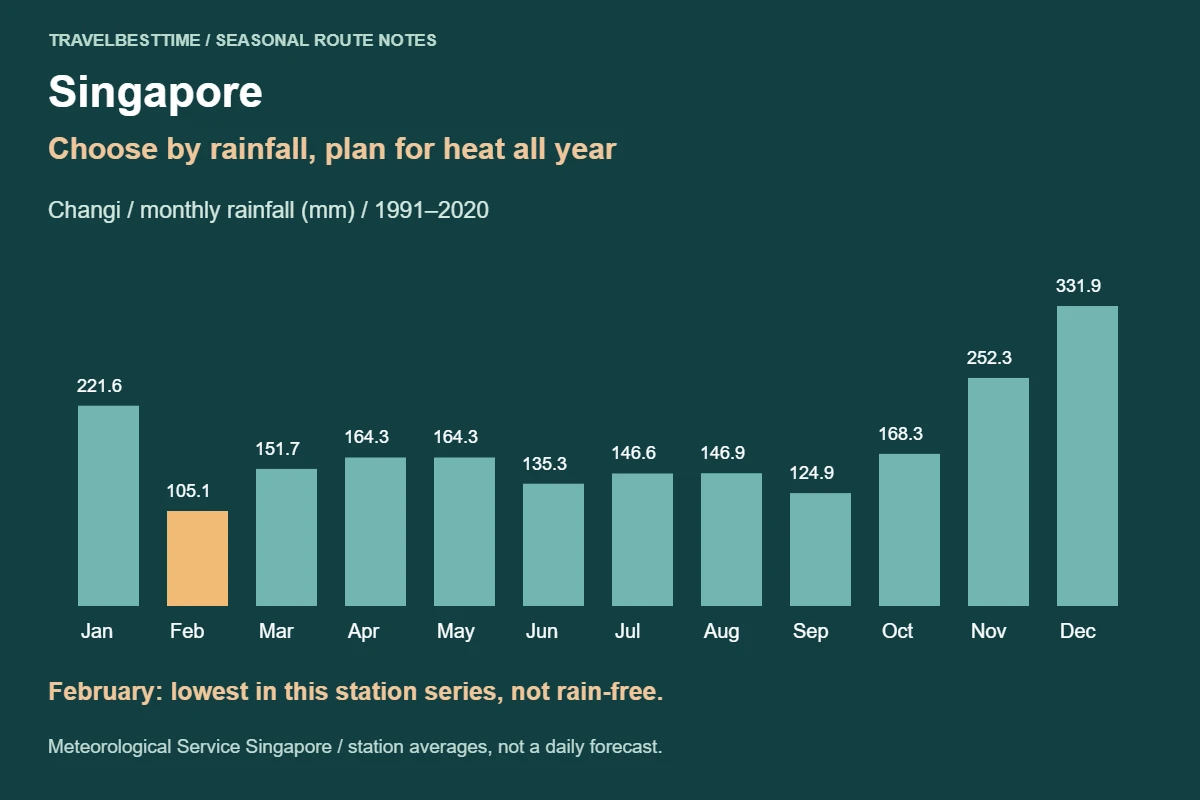
February is the driest month in the Meteorological Service Singapore’s Changi 1991–2020 reference record. That makes it a useful starting point for gardens and outdoor neighborhoods, not a guarantee of dry sightseeing. If a festival, family visit or stopover fixes your dates, Singapore still supports a workable itinerary in wetter months when you leave room to change plans.
Best time to visit Singapore for your priorities
| Priority | Suggested window | Tradeoff |
|---|---|---|
| Lower historical rainfall | February | Driest Changi month; rain remains possible |
| Gardens and walks | Any month with forecast-led pacing | Early walks and indoor breaks |
| Grand Prix 2027 | October 8–10 | Official announcement; recheck before booking |
| Museums and food | Year-round | Confirm individual opening hours |
| Wet-month stopover | November–January possible | Keep outdoor activities interchangeable |
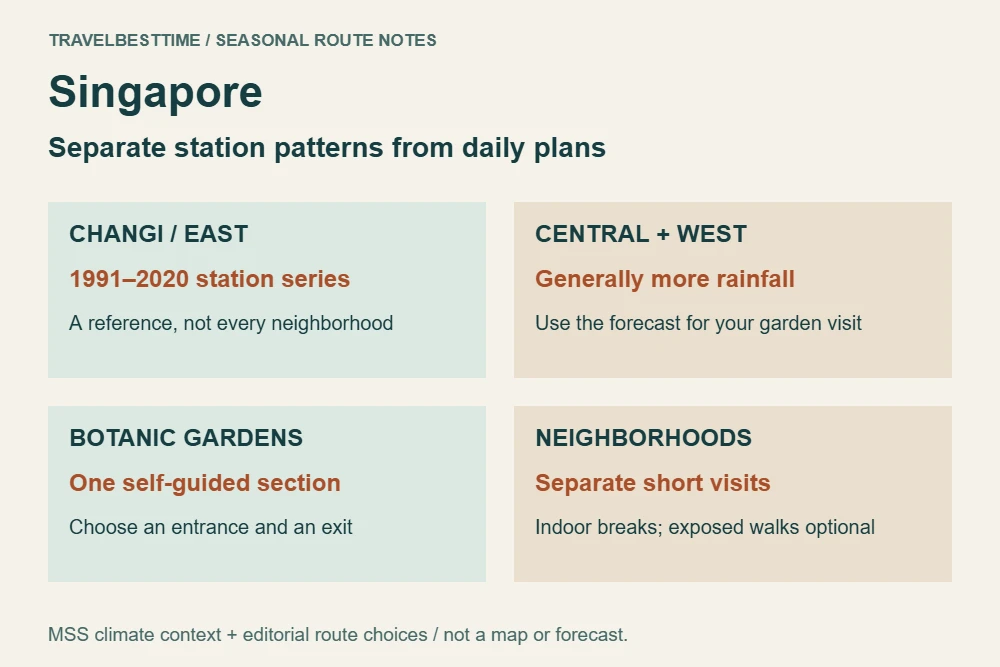
Think in terms of the trip you can enjoy comfortably. Someone visiting for restaurants, museums and an evening waterfront walk has less need to optimize monthly rainfall than someone planning several outdoor park days. A traveler who dislikes heat should build shorter walking sections and air-conditioned breaks in every month rather than waiting for a winter that Singapore does not have.
Understand the monsoons without inventing a dry season
The northeast monsoon runs from December into early March, with wetter spells more characteristic of its early phase and a relatively drier later phase. The southwest monsoon runs from June to September. Thunderstorms also matter between the monsoons. The Meteorological Service Singapore climate account supports these patterns; none fixes the timing of rain on a sightseeing day.
For a gardens-focused trip, February’s lower Changi rainfall makes it a useful starting choice. For a November–January stopover, put food and indoor culture at the center of the plan and fit gardens or the waterfront into suitable weather windows. A downpour and a prolonged monsoon wet spell call for different amounts of rearranging: neither means that every day of the month will be lost.
The official account describes more rainfall over central and western Singapore than toward the east. Changi’s station means therefore cannot predict conditions at the Botanic Gardens or in a particular neighborhood. Choose a garden section and its exit before starting; for Chinatown, Little India and Kampong Glam, plan each district as a separate visit with an indoor break rather than linking everything through long exposed walks.
For a stormy afternoon, a museum is a practical indoor alternative to an open garden or waterfront. This is an editorial route choice, not a guarantee that rain arrives after lunch. During thunder, use suitable shelter and follow official instructions; a tree, open lawn or exposed waterfront is not an alternative indoor attraction.
Monthly temperature and rainfall at Changi
Reference: Changi Climate Station. Historical period: 1991–2020. Mean temperature in °C; monthly rainfall in mm. Station climate source. These figures are not a forecast or a national average.
| Month | Mean temperature (°C) | Precipitation (mm) |
|---|---|---|
| January | 26.8 | 221.6 |
| February | 27.3 | 105.1 |
| March | 27.8 | 151.7 |
| April | 28.2 | 164.3 |
| May | 28.6 | 164.3 |
| June | 28.5 | 135.3 |
| July | 28.2 | 146.6 |
| August | 28.1 | 146.9 |
| September | 28.0 | 124.9 |
| October | 27.9 | 168.3 |
| November | 27.2 | 252.3 |
| December | 26.8 | 331.9 |
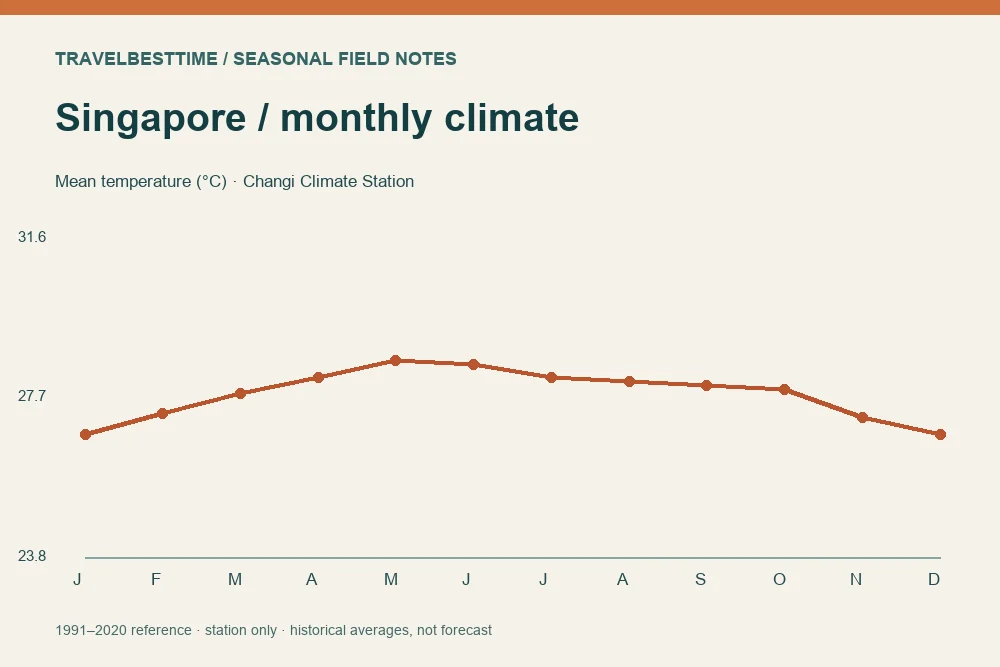
The table uses mean temperature, not average afternoon highs. A modest change in the mean does not describe how hot an exposed pavement feels, and rain totals cannot be converted into a percentage chance that your sightseeing day will be wet. Use these figures to understand the annual pattern, then use current local weather information for outdoor decisions.
Singapore month by month
January can bring wet northeast-monsoon spells. A waterfront hotel does not remove the need for indoor alternatives, so arrange museums, food stops and gardens as interchangeable parts of the day.
February is the clearest statistical starting point if rainfall is your deciding factor. Check the actual Lunar New Year calendar and individual business hours before assuming that the driest month is also the quietest.
March remains useful for a city break, with heat and rain still possible. Put your longest walk early in the day and leave a museum or indoor attraction for the warmest or wettest period.
April falls in an inter-monsoon period when thunderstorms matter. Avoid promising a fixed afternoon outdoor session; let the forecast decide whether the garden visit comes before or after lunch.
May has a high historical mean temperature at Changi. Choose accommodation with convenient transport and make your itinerary less dependent on long midday walks between neighborhoods.
June can suit a family trip fixed by school holidays. Check the dates that affect your own attractions and hotels rather than treating the southwest monsoon label as a guarantee of quieter conditions.
July still needs rain planning. Keep a spare slot for a postponed outdoor visit and check the day’s conditions before choosing an exposed coastal or island outing.
August brings National Day on August 9 each year. If celebrations interest you, consult the current official program; if you prefer a simpler route, check access and crowd arrangements around major venues.
September is not interchangeable with October for a race-focused visit. Use the announced calendar for the travel year, and avoid copying a past Grand Prix weekend into your booking plan.
October can combine thunderstorms with major events. For 2027, the official tourism listing gives the Singapore Grand Prix as October 8–10, with wider Grand Prix Season activities October 1–10.
November is among the wetter months in the station record. A shorter city stay can still work well if you treat outdoor photographs and garden visits as flexible opportunities rather than fixed appointments.
December has the highest rainfall total in this reference series. Plan a trip around food, culture and indoor choices, with outdoor time when conditions permit; do not promise an uninterrupted beach holiday.
Festivals and the verified 2027 race calendar
The Singapore Tourism Board’s Grand Prix Season page announces the 2027 race for October 8–10. That is a confirmed listing checked during research, subject to later organizer changes. Older 2026 activities remain on the same page, so take care to read the year attached to each item. Do not treat an old concert or pop-up as part of the future program.
Race travel and general sightseeing have different priorities. If attending the race, select accommodation and access around the ticket zone and official transport plan. If you are visiting for museums and neighborhoods, compare other dates and check the current street-access arrangements before deciding that a central location will be the most convenient.
Thaipusam is another reason to choose dates deliberately. The official tourism description explains the procession and associated road-lane closures. This guide does not establish an exact 2027 procession date. Confirm the dated organizer program, observe visitor instructions and treat the event as a religious observance rather than a photo opportunity detached from its meaning.
Lunar New Year, Hari Raya and Deepavali also require the correct annual calendar. Public-holiday dates do not automatically establish the dates of every bazaar, light display or performance. If a particular event is central to your trip, save its dated official announcement before making a nonrefundable reservation.
A four-day itinerary with room for rain
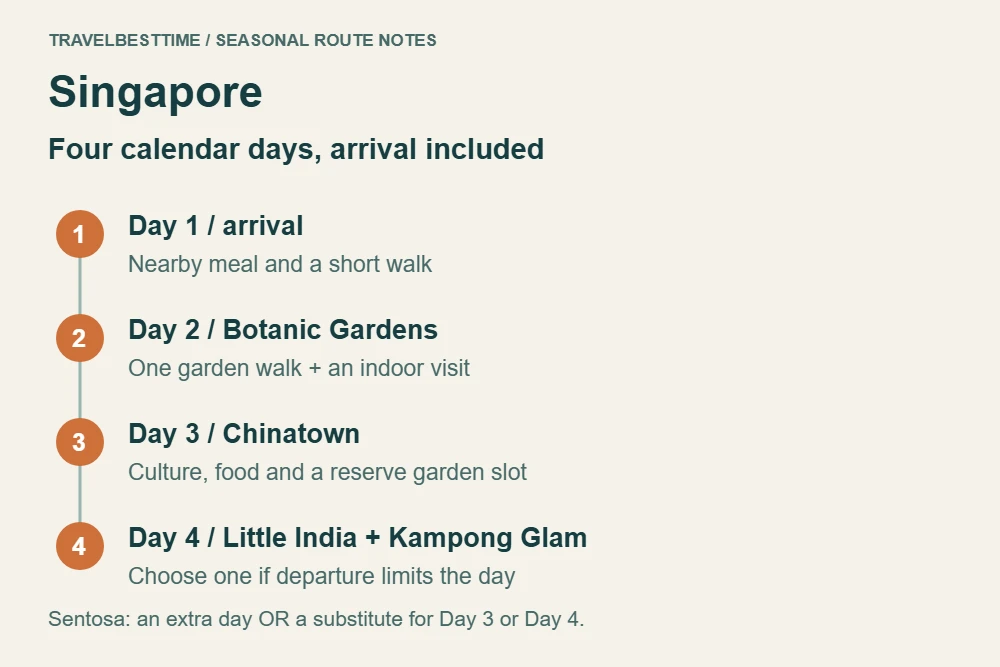
This itinerary counts arrival as Day 1: four calendar days, not an arrival day plus four full days. Shorten the final day to fit your departure; it is not a promise of four full sightseeing days.
Day 1 — Arrival and your own neighborhood. Settle in, have a meal and take a short walk near your accommodation if conditions permit. Save timed attractions for a day when arrival formalities and luggage will not compete with them.
Day 2 — Botanic Gardens and an indoor afternoon. Choose one self-guided walk from the official gardens visitor information rather than attempting every part of the grounds. Follow it with a museum visit selected for your interests. The museum is a separate stop, not a claim that it adjoins the gardens. If thunder rules out the walk, make the indoor visit the main activity and move the gardens to another suitable slot.
Day 3 — Chinatown. Give its cultural stops and food time together instead of using the district as a brief detour between islandwide reservations. Pick the particular places you want to enter, then build the walk around them. Keep the rest of the day available for a postponed garden visit or a longer indoor stop.
Day 4 — Little India and Kampong Glam. Treat these as two neighborhood visits with a break and a transfer between them, rather than one uninterrupted walk in the heat. If departure limits the day, choose one. An evening waterfront walk is optional when weather and flight plans allow.
Sentosa is an additional day or a substitute for Day 3 or Day 4, not a fifth day hidden inside this four-day plan. Choose it when its attractions are a main interest; avoid adding an island outing after two already substantial neighborhood visits. Attraction hours, tickets and weather-sensitive operations need their own checks.
Stopovers, families and outdoor pacing
For a one- or two-night stopover, choose a small number of priorities near practical transport. Allow for arrival formalities, luggage and your return to the airport. A late flight does not necessarily turn the whole final day into usable sightseeing time, particularly when you need to collect bags or change clothes after a humid walk.
Families may find that one major activity plus an optional neighborhood stop is more comfortable than a full sequence of timed entries. Keep water and a change of plan readily available. Avoid setting the day around an outdoor activity immediately before an expensive reservation on the other side of the city.
During thunder, move to suitable shelter and follow official instructions. Do not wait in an exposed waterfront or open park just because a booking is approaching. Before an outdoor excursion, check the local forecast and warnings; historical climate figures are a tool for choosing a month, not for judging whether a current storm is safe.
Booking and packing without cheapest-month claims
This guide has no verified hotel-rate or airfare series. A wetter month is not automatically the cheapest, and an event weekend can affect a specific area independently of the season. Compare your exact dates, room terms and transport convenience. A refundable reservation can be useful when the trip depends on an event whose detailed program is still pending.
Pack breathable clothing, a compact umbrella or rain layer, comfortable footwear and something light for strongly air-conditioned interiors. Keep electronics and essential documents protected from a sudden downpour. If you are connecting the trip with Malaysia, compare the coast you intend to visit rather than assuming that Singapore’s best month applies to every Malaysian island.
Use the Botanic Gardens as a flexible outdoor anchor
The Singapore Botanic Gardens visitor portal provides self-guided walking information and area or facility closure notices. Select one of those walks and identify its entrance and exit before setting out. A focused section leaves room for lunch and an indoor visit without turning a garden morning into an all-day endurance test.
On a short stay, give the gardens one preferred slot and one possible replacement slot. In the four-calendar-day plan, Day 2 is the preferred visit and the open part of Day 3 is the reserve. Move the walk according to actual conditions, not a rule that every tropical shower ends quickly.
General garden access, specialist attractions, guided experiences and restaurant reservations have separate admission or operating arrangements. Check only the components you intend to use. During thunder or an official closure, leave the outdoor plan for another slot; the monthly Changi table cannot establish that a particular path is safe.
Singapore travel FAQs
What is the driest month in Singapore?
February has the lowest mean monthly rainfall in Changi’s 1991–2020 record used here. Rain and thunderstorms remain possible, so keep indoor alternatives even when choosing that month.
Does Singapore have a dry season?
Singapore has comparatively wetter and drier periods, but no distinct rain-free dry season. The monsoon phases affect rainfall patterns while heat and humidity remain relevant throughout the year.
Is December too rainy for a Singapore stopover?
Not necessarily. December is the wettest month in the reference table, but a stopover focused on food, museums and flexible outdoor visits can still work. Avoid making every activity dependent on clear weather.
When is the Singapore Grand Prix in 2027?
The official tourism listing checked for this guide announces October 8–10, 2027. Recheck the organizer before booking and distinguish the race dates from wider Grand Prix Season activities.
Is Singapore cool enough for long walks in winter?
Singapore does not have a cool temperate winter. Plan shorter walking sections, indoor breaks and convenient transport in every month rather than expecting a winter escape from tropical heat.
How many days should I allow for a first visit?
Three or four full days is a practical editorial starting point for several neighborhood visits, gardens and indoor attractions. A short stopover needs a narrower plan; add time if you want multiple specialist or island outings.